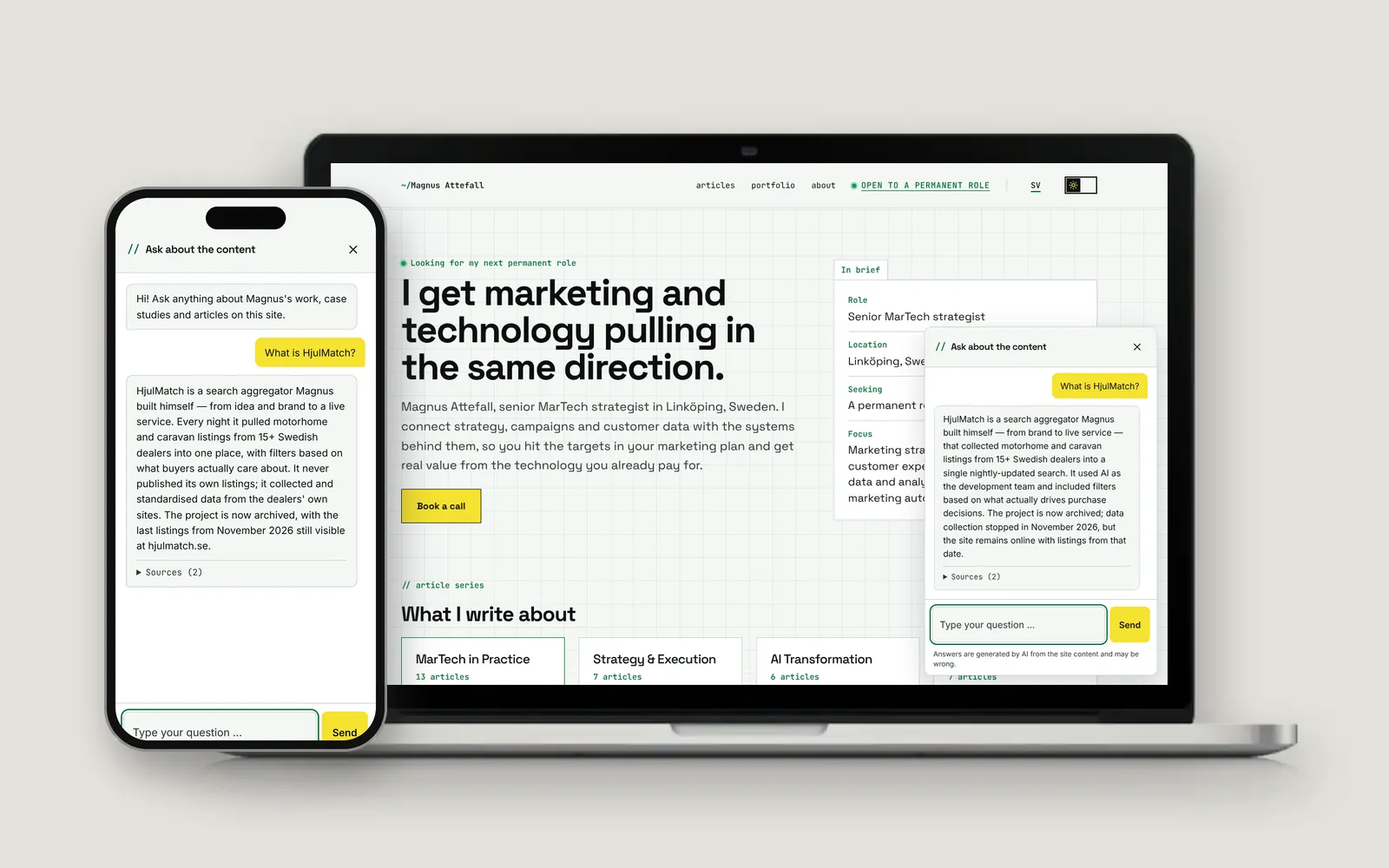
As attefall.se grew, the most useful content became the hardest to find. In 2026 I designed and built an AI assistant inside WordPress that lets visitors ask a question in their own words. The answer comes only from the site’s own articles and cases, with links to the sources.
The challenge
Cases, articles and pages about my experience were spread across the site. Menus and keyword search work when you know what you are looking for. A recruiter who wants to know whether I have worked with marketing automation in a regulated industry does not.
I also wanted to test in practice what generative AI can do for a website, beyond writing text.
My approach
I built the assistant as my own WordPress plugin. Every article and case is indexed, so the assistant can find the passages that match a question by meaning, even when the words differ. A language model then writes a short answer from those passages. The technique is called retrieval-augmented generation (RAG).
Trust mattered more than clever answers. The assistant only answers from indexed content and shows which pages it used. It works in Swedish and English and follows the language of the page.
Around it I built tools to manage the index and to follow how the assistant is used. It is part of the website I built for my job search and a place where I keep testing new AI tools.
The result
- Visitors find experience and articles by asking a question
- Answers based on my own content, with visible sources
- A working example of generative AI that helps visitors find things
What I built
- A WordPress plugin for the AI assistant
- Indexing of all articles and cases with search by meaning (vector embeddings in Supabase)
- Answers written by a language model, grounded in the site’s content
- Source links and rules that keep the assistant from making things up
- Support for Swedish and English
- Admin tools and usage tracking